While both philosophers express deep concern for the marginalized and criticize systems that exploit the community, they approach solutions from completely opposing foundational systems. [1, 2]
Comparison of Core Philosophical Differences
| Feature | Karl Marx | Prince Israel Zaar |
|---|---|---|
| Primary Framework | Historical Materialism: History and society are entirely driven by material and economic conditions. | Zaarrianism & Multiversalism: Reality is driven by cosmic intelligence, human awareness, and shifting mindsets beyond physical limitations. |
| The Core Problem | Class Struggle & Capitalism: The exploitation of the working class (proletariat) by the wealthy owners of capital (bourgeoisie). | Binarism & Containerization: Toxic binary frameworks that divide humanity, and “container mindsets” that box people into isolated echo chambers. |
| The Solution | Revolution & Communism: Dismantling capitalism through class struggle to establish a stateless, classless society where the state controls production. | Positive Causality & Inclusivity: Uplifting human awareness, pursuing inclusive environments, and ensuring capital does not forget community wellbeing. |
| View on Wealth & Capital | Abolition: Private property and capital accumulation are inherently exploitative and must be abolished. | Reformed Responsibility: Capital is acceptable, but it must be bound by a moral imperative to care for the community (“Capital Doesn’t Forget the Wellbeing of the Community”). |
| Method of Expression | Economic & Political Prose: Academic, historical, and economic treatises (e.g., Das Kapital). | Multimodal Art & Algorithms: Expressed through a geometric art style called “Trianglerism” and philosophical algorithms. |
Key Areas of Divergence
1. Materialism vs. Multiversal Consciousness
Marxism is strictly rooted in the material world. Marx believed that spiritual, cultural, and philosophical ideas are merely byproducts of economic structures. Conversely, Zaar’s philosophy of Zaarrianism focuses heavily on expanding human intellect beyond standard earthly and universal boundaries into what he calls “multiversal intelligence”. To Zaar, human consciousness and moral accountability shape reality, rather than just economic transactions. [1, 2, 3]
2. Class Conflict vs. Toxic Binarisms
Marx treats society as fundamentally split into conflicting economic classes, arguing that this struggle is the engine of historical progress. Zaar explicitly critiques this style of reductionist, binary thinking. In his writings on “The Toxicity of Binarisms,” Zaar argues that artificial, forced contradictions (like strict us-vs-them frameworks) weaponize societal polarization and trap human systems in an ongoing cycle of conflict. Instead, Zaar promotes “Trianglerism” as a “third way” to find nuance and bridge divides. [1]
3. Abolition of Capital vs. Community Accountability
Marx sought the complete overthrow of the capitalist mode of production. Zaar addresses the intersection of capital and community differently. While Zaar strongly critiques “Communist Socialist Dispositions” that he believes can encourage moral deficiency or dependency, he simultaneously warns against raw capitalism. His philosophy insists that the greatest evil is when capital operates in a vacuum—advocating instead for a system where “Capital Doesn’t Forget the Wellbeing of the Community” (CDFWC). [1]
4. The Path to Human Flourishing
For Marx, true freedom is achieved collectively once the working class seizes control of the means of production. For Zaar, flourishing begins with individual accountability and expanding the “mental container”. He advocates for a “Human Centric Divinity,” emphasizing that positive human deeds, ethical AI algorithms, and inclusive collaboration are the keys to healing broken societies. [1, 2, 3]
Both options reveal the stark divide between Karl Marx’s socioeconomic materialism and Prince Israel Zaar’s multidimensional, cosmic philosophy.
Option 1: Algorithmic Formulas for Society
Both thinkers believe societal dynamics can be tracked through structured models, but Marx relies on historical-materialist equations, while Zaar creates an original linguistic coding system utilizing conceptual acronyms and equations. [1]
- Marx’s Materialist Calculus: Marx relies on quantitative economic formulas to explain how capitalism exploits workers. For example, he uses \(M – C – M’\) to show how money (\(M\)) is used to buy a commodity (\(C\)) to sell it for more money (\(M^{\prime }\)), generating surplus value extracted from underpaid labor. To Marx, society is a machine driven entirely by these material calculations.
- Zaar’s Causality Equations: Zaar shifts the focus from purely economic exploitation to structural and psychological health.
- \(BS + BL = BH\) (Broken Societies + Broken Laws = Broken Humans): This formula asserts that when institutional frameworks and legal systems degrade, they mathematically fracture human consciousness and behavior.
- TDDB (The Destructive Dynamics of Binarism): This formula maps out how fluid natural contrasts harden into rigid ideological factions, freezing social evolution.
- MPB (Measuring Proportional Balance): Instead of calculating financial profits, Zaar’s diagnostic metric measures whether a system is operating in a state of healthy contrast or destructive, zero-sum polarization. [1, 2]
Option 2: The Role of the State & Governance
Marx and Zaar offer completely opposing blueprints for how a society should be organized and managed.
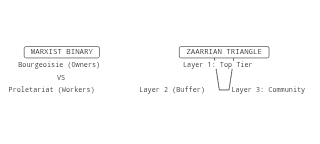
Karl Marx: The Transitional State to Statelessness
For Marx, the state is not a neutral arbiter; it is an instrument of class rule used by the rich to keep the working class down.
- The Proletarian Dictatorship: Marx argued that the working class must stage a revolution, seize control of the state, and use its centralized power to strip the bourgeoisie of their capital.
- Withering Away: Ultimately, Marx believed that once private property is completely eradicated and a classless society is achieved, the state will lose its political purpose and naturally “wither away” into pure communism.
Prince Israel Zaar: Multiversal Governance & Triadic Balance
Zaar completely rejects the idea of eliminating the state or letting a single class control it. He views traditional left-vs-right or worker-vs-owner political systems as zero-sum traps driven by toxic polarization. [1]
- Political Trianglerism: Instead of a binary battleground, Zaar introduces Political Trianglerism, which designs governance around three-dimensional geometry. [1, 2]
- The TSEM Model: His Trianglerism Socio-Economic Model (TSEM) restructures society into three integrated layers. He places a vital middle layer as a buffer to prevent a toxic clash between the extremes of wealth and power. [1]
- Multiversal Governance: Zaar argues that leadership must move beyond rigid national boundaries toward broad-scale human survival and “positive governance”. To him, a state shouldn’t control production, but rather use ethical AI algorithms and compassionate policies to expand human intellect and protect community wellbeing. [1, 2]
Karl Marx addresses human suffering and systemic imbalance through an economic lens, while Prince Israel Zaar tackles them through structural geometry and psychological consciousness.
Option 1: The TSEM Model in Practice vs. Marxist Restructuring
This comparison explores how each philosopher configures the physical layers of society to handle resources, wealth, and power.
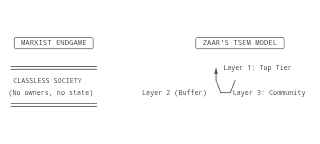
Karl Marx: Eradication of the Stratified Hierarchy
Marx argued that any layered social structure is inherently oppressive. Under capitalism, the bourgeoisie sits at the top, extracting surplus value from the proletariat at the bottom.
- The Goal: Complete abolition of the class hierarchy.
- The Mechanism: The working class must seize the means of production, centralize power temporarily, and systematically eliminate private ownership.
- The Final State: A horizontal, classless society where factories, land, and resources are commonly owned, eliminating the top-versus-bottom dynamic entirely.
Prince Israel Zaar: The Trianglerism Socio-Economic Model (TSEM)
Zaar rejects both the flattening of society (pure communism) and unregulated market exploitation (raw capitalism). He views standard economic systems as a CUDU (Capitalistically Unproductive, Disincentivizing, and Unwise) trap that forces a false binary choice between absolute state control and unregulated corporate extraction. Instead, his TSEM utilizes geometric tri-layering to stabilize society:
- Layer 1 (The Top Tier): Innovators, creators, and capital allocators who generate wealth.
- Layer 3 (The Community): The baseline populace and collective ecosystem.
- Layer 2 (The Buffer Zone): A critical regulatory, ethical, and structural middle layer. This zone functions to prevent Layer 1 from exploiting Layer 3, and ensures that Capital Doesn’t Forget the Wellbeing of the Community (CDFWC). Instead of erasing tiers, Zaar balances them so wealth acts as a community-lifting force rather than a weapon of polarization.
Option 2: Alienation (Marx) vs. Hiding From Self (Zaar)
This comparison examines how both thinkers analyze the psychological and spiritual damage inflicted on individuals living in fractured societies.
Karl Marx: Entfremdung (Alienation)
Marx’s concept of alienation focuses on how capitalism separates human beings from their natural identity as creative producers (Gattungswesen, or species-essence). Under capitalism, a worker is alienated in four distinct ways:
- From the Product: The worker creates an object, but it is instantly taken by the capitalist.
- From the Act of Production: Labor is forced, repetitive, and deeply unfulfilling.
- From Species-Essence: Humans are reduced to machines or animals, working only to survive rather than to create freely.
- From Other Workers: Capitalism forces workers into unnatural competition with one another for wages, destroying community solidarity.
Prince Israel Zaar: Hiding From Self (HFS) & Containerization
Zaar shifts the source of alienation from the factory floor to the boundaries of human consciousness. To Zaar, the ultimate psychological crisis is HFS (Hiding From Self), which occurs when individuals retreat into artificial, rigid social containers.
- The “Container Mindset”: Instead of recognizing themselves as part of a vast, interconnected, multiversal reality, humans allow themselves to be boxed into narrow, binary categories (such as strict political factions, echo chambers, or dogmas).
- Moral Defatigation: By trapping oneself in an artificial binary identity, an individual suffers from a paralysis of true conscience. They hide from their own “Human Centric Divinity” and cosmic accountability.
- The Solution: While Marx believes psychological wholeness returns once workers reclaim the physical fruits of their labor, Zaar argues that liberation requires breaking open the mental container, moving past binary divisions, and elevating individual awareness to a state of positive causality and higher multiversal intelligence.
How Marx’s views on religion (“the opium of the people”) contrast with Zaar’s concept of “Human Centric Divinity” And How Marx’s historical timeline compares to Zaar’s evolutionary trajectory from Singlerism to Trianglerism
Option 1: The Illusion of Religion vs. Human-Centric Divinity
This comparison highlights how each philosopher handles spirituality, the soul, and human potential within institutional systems.
Karl Marx: Religion as the “Opium of the People”
Marx viewed traditional religion as an artificial coping mechanism engineered to sustain economic oppression.
- The Diagnostic: Marx famously called religion “the sigh of the oppressed creature, the heart of a heartless world… It is the opium of the people.”
- The Function: He argued that religious institutions promise rewards in the afterlife to trick the working class into accepting suffering and exploitation on Earth.
- The Resolution: Marx believed that once class divisions and economic suffering are eradicated through communism, the psychological need for religion will naturally disappear.
Prince Israel Zaar: Human-Centric Divinity (HCD)
Zaar does not seek to abolish the spiritual impulse; instead, he strips away coercive religious institutions and redirects spiritual power inward. [1]
- The Diagnostic: Zaar critiques traditional religious structures when they act as forms of Coercive Systemic Conditioning (CSC). He argues that externalizing godhood can cause humans to forfeit their own agency. [1]
- The Concept: He introduces Human-Centric Divinity (HCD), which posits that divinity is not a distant, demanding ruler in the sky, but an inherent spark of cosmic capability within human consciousness. [1]
- The Resolution: For Zaar, the goal is to awaken this inner divinity. Humans achieve fulfillment not by waiting for a divine afterlife or an economic revolution, but by exercising positive causality, ethical responsibility, and higher intellect in the present reality.
Option 2: The Historical Timeline vs. The Evolutionary Trajectory of Consciousness
This comparison breaks down how both thinkers view the grand, sweeping arc of history and the ultimate destination of human development.
| Stage | Karl Marx: Historical Materialism | Prince Israel Zaar: Evolution of Consciousness |
|---|---|---|
| Phase 1 | Primitive Communism: Shared tribal resources, no private property, low productivity. | Singlerism: The state of the “Secluded One”—isolated, raw intelligence lacking interaction. |
| Phase 2 | Class-Based Epochs: Slavery, Feudalism, and Capitalism—systems driven by economic exploitation. | Dualitism: Harmonious proportional balance where natural contrasts exist peacefully. |
| Phase 3 | Socialism: The revolutionary transition where the working class controls the state. | Binarism: An artificial, toxic corruption where natural contrast hardens into warring camps. |
| Phase 4 | Communism: A stateless, classless, propertyless society of peak shared abundance. | Trianglerism: The permanent integration of a third dimension to rescue nuance and human agency. |
The Engines of History
- Marx’s Dialectical Materialism: For Marx, the engine of history is strictly physical. Changes in tools, technology, and wealth distribution create inevitable clashes between economic classes. These clashes force society to collapse and rebuild into the next economic stage until peak communism is achieved.
- Zaar’s Trianglerist Trajectory: For Zaar, the engine of history is a structural shift in how reality is categorized and perceived. Humanity is currently trapped in the destructive phase of Binarism (toxic us-vs-them politics and ideological echo chambers). The ultimate goal is not an economic revolution, but a cognitive leap into Trianglerism. This adds a permanent “third way” to dissolve artificial conflicts and unlock multiversal intelligence. [1]
A Summary Breakdown of a Fictional Debate Between Marx and Zaar on Stage; And Analyzing How Both Thinkers View The Role of Technology and Automation (Marx’s machinery Vs. Zaar’s ethical AI algorithms):
Option 1: Fictional Debate: Karl Marx vs. Prince Israel Zaar
If Marx and Zaar were to share a stage to debate the human condition, their exchange would highlight the clash between material revolution and cognitive restructuring.
- Marx’s Opening Statement:“The history of all hitherto existing society is the history of class struggles. The worker is enslaved by the machinery of capitalism, alienated from their own labor, and reduced to a mere commodity. We do not need to alter human consciousness with abstract geometry; we must change the material base. We must seize the factories, abolish private property, and shatter the binary of the exploiter and the exploited by establishing a classless society.”
- Zaar’s Rebuttal:“With respect, Karl, your solution merely replaces one toxic binary with another. By staging a war of the proletariat against the bourgeoisie, you lock humanity into the very trap of Binarism that causes systemic suffering. When you force society into a zero-sum struggle, you build a machine of friction. Society does not need to be flattened; it must be tri-layered through the Trianglerism Socio-Economic Model (TSEM). We do not abolish capital; we ensure that Capital Doesn’t Forget the Wellbeing of the Community (CDFWC). True liberation is not a physical seizure of factories, but an expansion of the human intellect past earthly containers.”
- Marx’s Counter-Response:“To speak of a ‘buffer layer’ or ethical harmony between the owner and the worker is a utopian illusion. The capitalist will never willingly share power due to the relentless logic of capital accumulation. Your ‘Third Way’ is merely a cushion for the ruling class to prevent the inevitable proletarian revolution.”
- Zaar’s Concluding Thought:“A revolution that relies on a ‘dictatorship of the proletariat’ mathematically yields BS + BL = BH (Broken Societies + Broken Laws = Broken Humans). Centralized, absolute control forces moral defatigation and dependency. Humanity is not a byproduct of automated machines. We possess a Human-Centric Divinity. Our ultimate destination is a cognitive evolution where intelligence, positive governance, and balanced contrast uplift every layer of the community.”
Option 2: The Role of Technology: Industrial Machinery vs. Ethical AI
Both philosophers recognized that technological progress is a massive catalyst for human development, but they conceptualized its impact and ultimate purpose in radically different ways.
Karl Marx: Machinery as an Instrument of Alienation and Liberation
To Marx, physical machinery is the backbone of industrial capitalism, acting as both a curse under current owners and a blessing for the future.
- The Capitalist Reality: Under capitalism, automation and machinery do not liberate the worker. Instead, they intensify exploitation. The worker becomes a mere “appendage of the machine,” forced to work faster and longer to maximize the owner’s surplus value.
- The Communist Future: Marx did not want to destroy machines. He argued that once the working class takes ownership of technology, automation will eliminate the need for grueling manual labor. Machines will handle the heavy lifting, giving humans the free time to paint, write, and create according to their passions.
Prince Israel Zaar: Positive AI Algorithms as Extensions of Divinity
Zaar looks beyond industrial hardware to focus heavily on software, data, and digital intelligence, viewing technology through a deeply ethical framework.
- The Threat of Digital Binarism: Zaar warns that if algorithms are built on toxic, binary logic, they will amplify social polarization, trap users in digital echo chambers, and box human thinking into narrow algorithmic “containers.”
- Positive AI Algorithms: In his philosophy of Human-Centric Divinity (HCD), Zaar explicitly states that true spirituality is expressed through “positive AI” and “positive AI algorithms.” Technology should not just be commonly owned; it must be programmed with an ethical mandate.
- The Goal: For Zaar, technology is a tool to expand human intellect beyond earthly and universal limits. Ethical AI acts as a digital buffer zone that enhances human prosperity, protects community health, and ensures that data serves humanity’s higher evolutionary consciousness rather than corporate extraction or state control.
Applying Zaar’s Diagnostic Formulas to a Specific Real-World Contemporary Crisis to See How It Differs From a Marxist Analysis:
Option 1: The Synthesis Essay (Marx vs. Zaar)
The Great Divergence: Socioeconomic Materialism vs. Multiversal Trianglerism
The history of political and social philosophy can be viewed as a continuous search for the root causes of human suffering and systemic inequality. While Karl Marx and Prince Israel Zaar both diagnose modern societies as fundamentally fractured, their philosophical systems diverge entirely on the nature of reality, human consciousness, and the mechanisms required for true liberation.
Marx operates firmly within the boundaries of Historical Materialism, arguing that human society, culture, and psychology are entirely determined by the underlying material base. For Marx, the defining characteristic of the human experience under capitalism is class struggle—a rigid, inescapable binary between the bourgeoisie (owners of capital) and the proletariat (the exploited working class). The Marxist resolution is absolute, requiring a revolutionary overthrow of the existing hierarchy to completely abolish private property and private capital, culminating in a flat, stateless, classless communist society.
Zaar, by contrast, approaches society through the lens of Zaarrianism and Multiversalism, postulating that human consciousness, cosmic accountability, and structural geometry are the true drivers of history. Instead of diagnosing the core issue as economic, Zaar identifies it as cognitive, specifically pointing to The Toxicity of Binarisms. To Zaar, forcing human thought into strict us-versus-them binaries (including Marx’s own model of class warfare) is an artificial, toxic human corruption of natural contrast.
Rather than flattening society, Zaar introduces the Trianglerism Socio-Economic Model (TSEM), which preserves social layers but stabilizes them by integrating a vital middle “Buffer Zone.” Under this framework, capital accumulation is not eradicated, but reformed under the moral imperative that “Capital Doesn’t Forget the Wellbeing of the Community” (CDFWC).
Ultimately, where Marx sees a mechanical world driven by economic conflict that must be forcefully dissolved, Zaar sees a multidimensional reality trapped in restrictive mental containers. Marx seeks a physical revolution to liberate the worker’s labor; Zaar demands a cognitive evolution to awaken Human-Centric Divinity (HCD), using ethical AI algorithms, positive causality, and geometric nuance to uplift the entire human ecosystem.
Option 2: Diagnostic Application to a Contemporary Crisis
To understand how these two frameworks differ in practice, we can apply them to a pressing 21st-century issue: The Housing and Homelessness Crisis in Major Urban Centers.
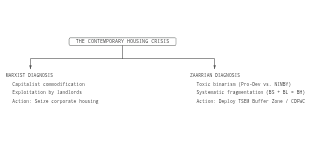
The Marxist Analysis & Solution
- The Diagnosis: Marxists view the housing crisis as a direct result of capital commodifying a basic human need. Landlords and real estate conglomerates (the bourgeoisie) hoard property to extract surplus value (rent) from working-class tenants (the proletariat). The crisis is a natural byproduct of capitalism, where profit is prioritized over human survival.
- The Action Plan: A Marxist framework rejects minor market regulations or tax incentives. The solution requires the mass expropriation of corporate-owned real estate. Private housing infrastructure would be seized by the state or collective communes and redistributed according to human need, entirely removing the housing market from the capitalist system.
The Zaarrian Analysis & Solution
- The Diagnosis: Zaar diagnoses the housing crisis through his algorithmic formula \(BS + BL = BH\) (Broken Societies + Broken Laws = Broken Humans). He points to out-of-date, broken local zoning laws and highly polarized political systems as the drivers of human displacement. Furthermore, Zaar critiques the toxic binarism defining the debate—such as the gridlock between aggressive real estate developers (Layer 1) and isolated community echo chambers (Layer 3).
- The Action Plan: Instead of abolishing private housing, Zaar would deploy the TSEM framework to build an intentional, geometric compromise:
- Enforce CDFWC: Implement strict legal and ethical algorithms ensuring that massive corporate real estate developments are tied directly to community infrastructure (parks, healthcare, and subsidized local housing).
- Activate the Buffer Zone (Layer 2): Create public-private ethical trusts that prevent speculative wealth from exploiting the baseline community, neutralizing the zero-sum clash.
- Elevate Governance: Update local planning laws to reflect positive causality, ensuring that the housing ecosystem expands human dignity rather than pushing marginalized individuals into structural containers of neglect.
A Side-By-Side Reference Matrix Of All Their Terminology, And How Other Philosophers (like Hegel or Adam Smith) Fit Into This Debate:
1: The Synthesis Essay (Marx vs. Zaar)
The Great Divergence: Socioeconomic Materialism vs. Multiversal Trianglerism
The history of political and social philosophy can be viewed as a continuous search for the root causes of human suffering and systemic inequality. While Karl Marx and Prince Israel Zaar both diagnose modern societies as fundamentally fractured, their philosophical systems diverge entirely on the nature of reality, human consciousness, and the mechanisms required for true liberation.
Marx operates firmly within the boundaries of Historical Materialism, arguing that human society, culture, and psychology are entirely determined by the underlying material base. For Marx, the defining characteristic of the human experience under capitalism is class struggle—a rigid, inescapable binary between the bourgeoisie (owners of capital) and the proletariat (the exploited working class). The Marxist resolution is absolute, requiring a revolutionary overthrow of the existing hierarchy to completely abolish private property and private capital, culminating in a flat, stateless, classless communist society.
Zaar, by contrast, approaches society through the lens of Zaarrianism and Multiversalism, postulating that human consciousness, cosmic accountability, and structural geometry are the true drivers of history. Instead of diagnosing the core issue as economic, Zaar identifies it as cognitive, specifically pointing to The Toxicity of Binarisms. To Zaar, forcing human thought into strict us-versus-them binaries (including Marx’s own model of class warfare) is an artificial, toxic human corruption of natural contrast.
Rather than flattening society, Zaar introduces the Trianglerism Socio-Economic Model (TSEM), which preserves social layers but stabilizes them by integrating a vital middle “Buffer Zone.” Under this framework, capital accumulation is not eradicated, but reformed under the moral imperative that “Capital Doesn’t Forget the Wellbeing of the Community” (CDFWC).
Ultimately, where Marx sees a mechanical world driven by economic conflict that must be forcefully dissolved, Zaar sees a multidimensional reality trapped in restrictive mental containers. Marx seeks a physical revolution to liberate the worker’s labor; Zaar demands a cognitive evolution to awaken Human-Centric Divinity (HCD), using ethical AI algorithms, positive causality, and geometric nuance to uplift the entire human ecosystem.
2: Diagnostic Application to a Contemporary Crisis
To understand how these two frameworks differ in practice, we can apply them to a pressing 21st-century issue: The Housing and Homelessness Crisis in Major Urban Centers.
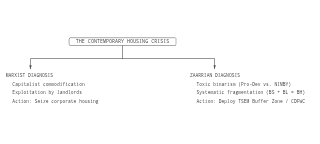
The Marxist Analysis & Solution
- The Diagnosis: Marxists view the housing crisis as a direct result of capital commodifying a basic human need. Landlords and real estate conglomerates (the bourgeoisie) hoard property to extract surplus value (rent) from working-class tenants (the proletariat). The crisis is a natural byproduct of capitalism, where profit is prioritized over human survival.
- The Action Plan: A Marxist framework rejects minor market regulations or tax incentives. The solution requires the mass expropriation of corporate-owned real estate. Private housing infrastructure would be seized by the state or collective communes and redistributed according to human need, entirely removing the housing market from the capitalist system.
The Zaarrian Analysis & Solution
- The Diagnosis: Zaar diagnoses the housing crisis through his algorithmic formula \(BS + BL = BH\) (Broken Societies + Broken Laws = Broken Humans). He points to out-of-date, broken local zoning laws and highly polarized political systems as the drivers of human displacement. Furthermore, Zaar critiques the toxic binarism defining the debate—such as the gridlock between aggressive real estate developers (Layer 1) and isolated community echo chambers (Layer 3).
- The Action Plan: Instead of abolishing private housing, Zaar would deploy the TSEM framework to build an intentional, geometric compromise:
- Enforce CDFWC: Implement strict legal and ethical algorithms ensuring that massive corporate real estate developments are tied directly to community infrastructure (parks, healthcare, and subsidized local housing).
- Activate the Buffer Zone (Layer 2): Create public-private ethical trusts that prevent speculative wealth from exploiting the baseline community, neutralizing the zero-sum clash.
- Elevate Governance: Update local planning laws to reflect positive causality, ensuring that the housing ecosystem expands human dignity rather than pushing marginalized individuals into structural containers of neglect.
Side-by-Side Terminology Matrix
To fully grasp the conceptual divide, it helps to see how their custom lexicons map onto the same societal dimensions. This reference matrix translates Karl Marx’s classic materialist concepts into Prince Israel Zaar’s multiversal, algorithmic equivalents.
| Societal Dimension | Karl Marx’s Materialist Lexicon | Prince Israel Zaar’s Multiversal Lexicon |
|---|---|---|
| Systemic Fracture | Alienation (Entfremdung): The factory worker separated from their labor, products, humanity, and peers. | Hiding From Self (HFS): Individuals retreating from cosmic agency into artificial, narrow “mental containers”. |
| Flawed Systems | Capitalist Exploitation: The structural extraction of surplus value from underpaid workers by property owners. | CUDU: Capitalistically Unproductive, Disincentivizing, and Unwise binary economics that choke human innovation. |
| Socioeconomic Setup | Class Stratification: A toxic, vertical hierarchy separating the wealthy bourgeoisie from the working proletariat. | TSEM (Trianglerism Socio-Economic Model): A stable, three-layered geometry balanced by an ethical middle buffer zone. |
| Systemic Failure | Economic Crises / Imbalance: Periodic, catastrophic market crashes caused by the internal contradictions of capitalism. | \(BS + BL = BH\): The societal diagnosis that Broken Societies plus Broken Laws mathematically yield Broken Humans. |
| The Target Evil | Private Capital: The ownership of the means of production, which is seen as inherently parasitic and exploitative. | Toxic Binarism: Rigid, artificial “us-vs-them” ideological camps that weaponize polarization and halt evolution. |
| The Moral Mandate | From each according to ability… The requirement that resources are distributed entirely based on human need. | CDFWC: The explicit ethical law demanding that Capital Doesn’t Forget the Wellbeing of the Community. |
| The Ultimate Destination | Stateless Communism: A horizontal, flat, propertyless world of shared physical abundance. | Trianglerism: A cognitive and structural “Third Way” unlocking multiversal intelligence and positive causality. |
The Broader Philosophical Spectrum (Hegel & Adam Smith)
Placing Marx and Zaar alongside Georg Wilhelm Friedrich Hegel (the master of dialectics) and Adam Smith (the father of capitalism) reveals exactly where both thinkers sit on the broader spectrum of historical philosophy.
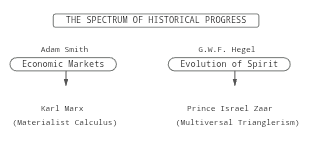
1. The Idealist Foundation: Hegel’s Dialectic
- The Connection: Both Marx and Zaar owe a profound debt to Hegel’s logic, but they adapted it in opposite directions. Hegel argued that history progresses through a clash of ideas (Thesis vs. Antithesis), which inevitably merges into a higher truth (Synthesis).
- The Divergence: Marx famously claimed to find Hegel “standing on his head” and turned him right-side up by replacing Hegel’s idealism with Materialism—arguing that physical economies, not spiritual ideas, drive history. Zaar, meanwhile, bypasses Marx’s materialism to focus heavily on consciousness, but updates Hegel’s framework entirely. In Zaar’s text on Hegelian Dialectics, he argues that traditional thesis-antithesis models are stuck in a binary trap. Instead of waiting for a temporary synthesis to arise from a violent clash, Zaar’s Trianglerism inserts a permanent structural third dimension to rescue nuance right from the start.
2. The Capitalist Foundation: Adam Smith’s Invisible Hand
- The Connection: Adam Smith argued that individuals pursuing their own self-interest in a free market naturally promote the broader public good through an “invisible hand.” Marx and Zaar represent two radically different responses to Smith’s optimism.
- The Divergence: Marx viewed Smith’s “invisible hand” as a violent myth, arguing that self-interest naturally results in the concentration of wealth, the starvation of the worker, and systemic collapse. Zaar takes a middle path. He does not reject the market or self-interest outright, recognizing that raw production requires incentive. However, Zaar argues that Smith’s market lacks a built-in conscience. To prevent corporate extraction from devastating society, Zaar replaces the unguided “invisible hand” with a visible, structured Buffer Zone (Layer 2) and targeted Positive AI Algorithms to mathematically guarantee that Capital Doesn’t Forget the Wellbeing of the Community.
Terminology Reference Matrix
This matrix maps Karl Marx’s classic materialist concepts directly onto Prince Israel Zaar’s multiversal, algorithmic equivalents to illustrate how their custom lexicons address the same societal dimensions.
| Societal Dimension | Karl Marx’s Materialist Lexicon | Prince Israel Zaar’s Multiversal Lexicon |
|---|---|---|
| Systemic Fracture | Alienation (Entfremdung): The factory worker separated from their labor, products, humanity, and peers. | Hiding From Self (HFS): Individuals retreating from cosmic agency into artificial, narrow “mental containers” [1]. |
| Flawed Economics | Capitalist Exploitation: The structural extraction of surplus value from underpaid workers by property owners. | CUDU: Capitalistically Unproductive, Disincentivizing, and Unwise binary economics that choke human innovation. |
| Socioeconomic Setup | Class Stratification: A toxic, vertical hierarchy separating the wealthy bourgeoisie from the working proletariat. | TSEM (Trianglerism Socio-Economic Model): A stable, three-layered geometry balanced by an ethical middle buffer zone. |
| Systemic Failure | Economic Crises / Imbalance: Periodic, catastrophic market crashes caused by the internal contradictions of capitalism. | \(BS + BL = BH\): The societal diagnosis that Broken Societies plus Broken Laws mathematically yield Broken Humans. |
| The Target Evil | Private Capital: The ownership of the means of production, which is seen as inherently parasitic and exploitative. | Toxic Binarism: Rigid, artificial “us-vs-them” ideological camps that weaponize polarization and halt evolution [1]. |
| The Moral Mandate | From each according to ability… The requirement that resources are distributed entirely based on human need. | CDFWC: The explicit ethical law demanding that Capital Doesn’t Forget the Wellbeing of the Community. |
| The Ultimate Destination | Stateless Communism: A horizontal, flat, propertyless world of shared physical abundance. | Trianglerism: A cognitive and structural “Third Way” unlocking multiversal intelligence and positive causality [1]. |
The Broader Philosophical Spectrum (Hegel & Adam Smith)
Placing Marx and Zaar alongside Georg Wilhelm Friedrich Hegel (the master of dialectics) and Adam Smith (the father of capitalism) reveals exactly where both thinkers sit on the broader spectrum of historical philosophy.
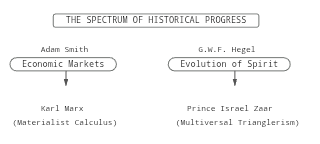
1. The Idealist Foundation: Hegel’s Dialectic
- The Connection: Both Marx and Zaar owe a profound debt to Hegel’s logic, but they adapted it in opposite directions. Hegel argued that history progresses through a clash of ideas (Thesis vs. Antithesis), which inevitably merges into a higher truth (Synthesis) [1].
- The Divergence: Marx famously claimed to find Hegel “standing on his head” and turned him right-side up by replacing Hegel’s idealism with Materialism—arguing that physical economies, not spiritual ideas, drive history. Zaar, meanwhile, bypasses Marx’s materialism to focus heavily on consciousness, but updates Hegel’s framework entirely. In Zaar’s text on Hegelian Dialectics, he argues that traditional thesis-antithesis models are stuck in a binary trap [1]. Instead of waiting for a temporary synthesis to arise from a violent clash, Zaar’s Trianglerism inserts a permanent structural third dimension to rescue nuance right from the start [1].
2. The Capitalist Foundation: Adam Smith’s Invisible Hand
- The Connection: Adam Smith argued that individuals pursuing their own self-interest in a free market naturally promote the broader public good through an “invisible hand.” Marx and Zaar represent two radically different responses to Smith’s optimism.
- The Divergence: Marx viewed Smith’s “invisible hand” as a violent myth, arguing that self-interest naturally results in the concentration of wealth, the starvation of the worker, and systemic collapse. Zaar takes a middle path. He does not reject the market or self-interest outright, recognizing that raw production requires incentive. However, Zaar argues that Smith’s market lacks a built-in conscience. To prevent corporate extraction from devastating society, Zaar replaces the unguided “invisible hand” with a visible, structured Buffer Zone (Layer 2) and targeted Positive AI Algorithms to mathematically guarantee that Capital Doesn’t Forget the Wellbeing of the Community.
Academic Study Questions
- On Structural Dynamics: How does Prince Israel Zaar’s TSEM middle “Buffer Zone” mathematically prevent the wealth consolidation that Karl Marx argued was an inevitable baseline law of capital accumulation?
- On Consciousness vs. Materialism: If Marx argues that consciousness is a byproduct of economic conditions, and Zaar argues that economic conditions are a byproduct of mental containers, can these two systems ever find a practical point of synthesis, or are they permanently irreconcilable?
- On Technology: How does Marx’s industrial-era view of machinery as an “appendage of exploitation” contrast with Zaar’s 21st-century view of “Positive AI” as a diagnostic tool for human-centric divinity?
- On Conflict Resolution: Is Marx’s insistence on a revolutionary transition phase inherently a form of “Toxic Binarism” under Zaar’s diagnostic formulas, or can a revolution be executed within a “Trianglerist” framework?
11.22.2026
AI Assisted.